

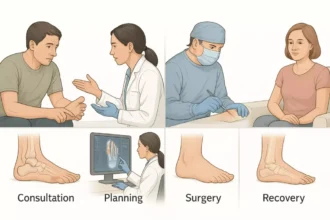


Mohs surgery is a specialized procedure for treating skin cancer, and it removes cancerous tissue layer by layer. The surgeon examines each layer under a microscope, and the process continues until no evidence of cancer remains. Mohs surgery also uses a tumor map to track each tissue section, so the surgeon knows where additional cancer cells are located. The procedure combines tissue removal, microscopic examination, and careful mapping.
Examining and Numbing the Area
Mohs surgery begins with an examination of the visible lesion. The surgeon evaluates the tumor and plans which tissue to remove, and the patient then receives local anesthesia. Skin cancer roots may extend beyond the visible tumor, and if those roots remain, the cancer can recur. Once the area is numb, the procedure begins.
Removing Tissue in Layers
The surgeon first removes the visible portion of the tumor. A deeper layer then comes out, and the surgeon divides that tissue into sections. Technicians color-code the sections with dyes, and reference marks show where each section came from. This process allows the surgeon to track each piece, and it helps limit removal to tissue containing cancer.
Mapping and Examining Tissue
A surgical map tracks the origin of each tissue section. The surgeon marks the site, and each section receives a corresponding location on the map. The tissue then goes to a laboratory, where the surgeon examines its undersurface and edges with a microscope. If cancer cells remain, the surgeon marks their location, and another layer is removed only from the corresponding area.
The surgeon repeats this process until no evidence of cancer remains. Each round provides more information, and the map guides the next area of removal when cancer cells are found. This stepwise approach removes cancer-containing tissue while preserving as much healthy tissue as possible.
Mohs surgery treats basal cell carcinomas, squamous cell carcinomas, and melanomas, and it also treats nearly all other types of skin cancer. The procedure continues until the tissue margins are clear, so the surgeon can then discuss reconstruction options if they are needed. Reconstruction restores the treated area’s function and appearance, and it is performed the same day or the following day depending on the extent of the cancer.
Preparation also forms part of the process. Patients stop smoking and avoid medications that thin the blood about two weeks before surgery, and certain supplements or alcohol restrictions may also apply. The procedure uses local anesthesia, and post-operative care follows after the surgical site is treated.
Managing Recovery After Surgery
Recovery typically lasts about one to two weeks. Bruising and pain are expected to some degree, and a scar forms at the surgical site. Patients follow post-operative instructions, rest during the week after surgery, and avoid exercise for at least 48 hours. A balanced diet and adequate fluids also form part of the recovery guidance, while reconstruction addresses the treated area’s needs when required.
Discuss the Mohs Surgery Process
Mohs surgery uses a structured process to remove skin cancer. The surgeon maps the tissue, examines each layer, and removes additional tissue when cancer cells remain. Once the margins are clear, the surgeon discusses reconstruction and post-operative care, so treatment can proceed to the next stage.